

Understanding BTU for House Size: The Foundation of Comfort
BTU for house size is the key metric that determines whether your heating and cooling system can keep your entire home comfortable. If you’re looking for a quick answer: a 1,000-square-foot home typically needs 20,000-30,000 BTUs for heating and around 20,000 BTUs for cooling, while a 2,000-square-foot home generally requires 40,000-60,000 BTUs for heating and approximately 40,000 BTUs for cooling. However, these are just starting points—your actual needs depend on factors like insulation, ceiling height, and climate.
Quick BTU Estimates by House Size:
- 1,000 sq ft: 20,000-30,000 BTUs (heating), ~20,000 BTUs (cooling)
- 1,500 sq ft: 30,000-45,000 BTUs (heating), ~30,000 BTUs (cooling)
- 2,000 sq ft: 40,000-60,000 BTUs (heating), ~40,000 BTUs (cooling)
- 2,500 sq ft: 50,000-75,000 BTUs (heating), ~50,000 BTUs (cooling)
Many Puyallup homeowners struggle with HVAC systems that can’t keep up with demand or run constantly without delivering consistent comfort. The problem often traces back to incorrect sizing—choosing equipment based on guesswork rather than your home’s actual heating and cooling requirements. Whether you’re replacing an old system or installing climate control for the first time, understanding how to calculate total BTU needs ensures you invest in equipment that works efficiently for your specific situation.
If you’re experiencing uneven temperatures or high energy bills, it may be time to explore air conditioning or heating solutions properly matched to your home. For expert HVAC assessment and installation in Puyallup, contact WestCoast Heating & Air today.
This guide walks you through the process of determining your home’s total BTU requirements, from basic square footage calculations to the critical factors that affect your final number. You’ll learn why simple formulas are just a starting point, what variables can dramatically change your needs, and why professional sizing matters for long-term comfort and efficiency.
What is a BTU and Why Does It Matter for HVAC Sizing?
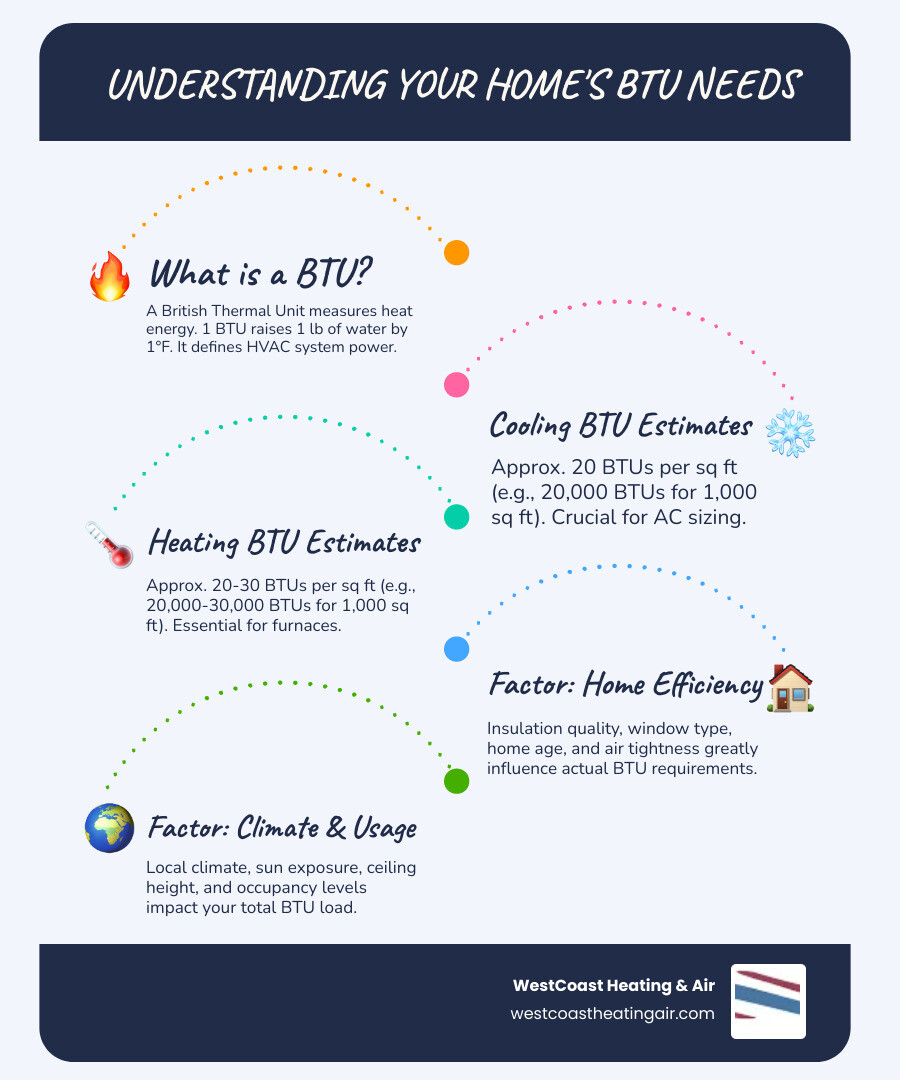
Before we dive into calculations, let’s clarify what a BTU is. BTU stands for British Thermal Unit, and it’s a fundamental unit of energy measurement. Specifically, one BTU is the amount of heat required to raise the temperature of one pound of water by one degree Fahrenheit. Think of it like this: the energy released by burning a single match is roughly one BTU!
When it comes to HVAC systems, a BTU rating indicates the system’s capacity to either add heat to your home (for heating) or remove heat from it (for cooling). A higher BTU rating means a greater capacity for heating or cooling. Understanding this measurement is crucial because it directly translates to how effectively your system can maintain your desired indoor temperature. Without the right BTU capacity, your system simply won’t be able to keep your home comfortable, regardless of how new or advanced it is.
For a deeper dive into this essential measurement, you can find more info about what is btu measurement and why does it matter.
How BTUs Relate to Different HVAC Systems
The concept of BTUs applies across all types of heating and cooling equipment, though how we talk about them might vary slightly:
- Air Conditioning: For air conditioning units, the BTU rating measures their cooling capacity – how much heat they can remove from your home per hour. For instance, a 12,000 BTU AC unit can remove 12,000 BTUs of heat from your indoor air every hour.
- Furnaces: A gas furnace (or electric furnace) has a BTU output rating that tells you how much heat it can generate and distribute throughout your home. A 60,000 BTU furnace can produce 60,000 BTUs of heat per hour.
- Heat Pumps: Heat pumps are unique because they can both heat and cool. Their BTU rating will typically specify separate heating and cooling capacities, as their efficiency can vary depending on the mode and outdoor temperature.
- Ductless Systems: Ductless heating and cooling systems, often called mini-splits, also come with BTU ratings for both heating and cooling. These are particularly useful for zoned comfort, as each indoor unit can have a specific BTU capacity custom to the room it serves.
Whether you’re cooling with an AC or heating with a furnace, the BTU rating is your system’s power indicator. It’s the core specification that determines whether your HVAC equipment is up to the task of maintaining comfort in your home.
A Starting Point: Calculating BTU for House Size with Rules of Thumb
When you first start thinking about your home’s heating and cooling needs, square footage is often the first thing that comes to mind. It’s a good starting point for a rough estimate, providing a general rule of thumb for calculating BTU for house size. However, these are simplified calculations and don’t account for your home’s unique characteristics.
Simple Formulas for Estimating BTU for House Size
The most common rule of thumb involves multiplying your home’s square footage by a certain BTU factor.
- For Cooling (AC): A widely accepted estimate is to multiply your home’s total square footage by 20. So, for a 2,000 sq. ft. home, you would need approximately 40,000 BTUs of cooling capacity. Our research indicates that a 2,000 sq. ft. home typically needs about 40,000 BTUs for cooling.
- For Heating (Furnace): A basic rule of thumb suggests 30 BTUs for every square foot of house. Therefore, a 2,000 sq. ft. home would theoretically need around 60,000 BTUs for heating. However, this can vary significantly by climate. For instance, in colder climates like some parts of the Pacific Northwest, you might need to multiply by 30-40 BTUs per square foot. Most 2,000-square-foot homes need a furnace between 50,000 and 65,000 BTUs, depending on climate and insulation.
Here’s a table illustrating approximate BTU needs based on these general guidelines for common house sizes:
| House Size (Square Feet) | Estimated Cooling BTUs (AC) | Estimated Heating BTUs (Furnace) |
|---|---|---|
| 1,000 sq ft | ~20,000 BTUs | 20,000-30,000 BTUs (or more in cold climates) |
| 1,500 sq ft | ~30,000 BTUs | 30,000-45,000 BTUs |
| 2,000 sq ft | ~40,000 BTUs | 50,000-65,000 BTUs |
| 2,500 sq ft | ~50,000 BTUs | 60,000-75,000 BTUs |
That these are very general guidelines. For a single room, a simpler formula is to multiply the room’s square footage by 25 BTUs. This might be useful for sizing a window AC unit or a ductless mini-split for a specific area.
Converting BTUs to Tons for Your Air Conditioner
While smaller AC units (like window units) are often rated directly in BTUs, central air conditioning systems are typically sized in “tons.” This can sometimes be confusing, but the conversion is straightforward:
- 1 Ton of cooling capacity is equivalent to 12,000 BTUs per hour.
So, if our estimate for a 2,000 sq. ft. home requires 40,000 BTUs of cooling, you would divide 40,000 by 12,000 to get approximately 3.33 tons. This means you’d likely be looking at a 3-ton or 3.5-ton central AC unit. A 4-ton furnace (or HVAC unit) typically covers around 2,000 to 2,400 square feet, which aligns with these estimates. This conversion is standard for central air conditioning systems, and it’s how professionals discuss the capacity of larger cooling units.
Beyond Square Footage: Critical Factors That Influence Your Home’s BTU Needs
While square footage provides a baseline, relying solely on it for calculating BTU for house size is like trying to bake a cake with only one ingredient. Many other critical factors influence your home’s actual heating and cooling load. These variables can significantly increase or decrease your actual BTU requirements compared to simple estimates, making accurate sizing a complex task that demands a more detailed assessment.
Climate and Location
The climate zone where your home is located is arguably one of the most significant factors influencing your BTU needs. Living in the Pacific Northwest, specifically around Puyallup, Tacoma, or Sumner, means we experience a unique blend of moderate temperatures, but also distinct heating and cooling seasons.
- Temperature Extremes: Homes in areas with colder winters will naturally require higher heating BTUs, while those in hotter summers will need higher cooling BTUs. Even within the PNW, microclimates can exist.
- Sunlight Exposure: The amount of direct sunlight your home receives can dramatically impact cooling needs. South-facing windows, for example, can contribute significant heat gain, especially in the summer, requiring more BTUs to cool. Conversely, they can aid in passive heating during winter.
- Humidity: While not directly measured in BTUs, high humidity makes you feel warmer, increasing the demand on your AC to remove moisture from the air, effectively increasing the cooling load.
Your local weather patterns are a primary driver of heating and cooling demand, so a generalized BTU per square foot rule won’t cut it for optimal comfort and efficiency in our region.
Home Construction and Efficiency
The way your home is built and its current state of energy efficiency play a massive role in how many BTUs it truly needs.
- Insulation Quality: This is paramount. Good insulation acts as a barrier, slowing down heat transfer into or out of your home. A home with poor insulation will lose heat quickly in winter and gain it rapidly in summer, demanding a much higher BTU capacity from your HVAC system. The R-value measures a material’s resistance to heat flow; a higher R-value indicates better insulation.
- Window Type: Single-pane windows are notorious for heat loss and gain. Double-glazed (or triple-pane) windows, especially those with low-emissivity coatings, offer much better thermal performance. Rooms with many windows typically have poorer insulation and will require more BTUs.
- Home Age: Generally, newer homes are built with stricter energy codes and better insulation, requiring fewer BTUs per square foot compared to older homes. Homes built before 1950, for example, consume significantly more energy for heating than homes built after 2010. If your home is older, it might need higher BTU capacity unless it has undergone significant energy-efficiency upgrades.
- Airtightness: Gaps and cracks around windows, doors, and foundations allow conditioned air to escape and unconditioned air to enter. A drafty home will require more BTUs to maintain comfort.
A well-insulated, modern home will require fewer BTUs than an older, drafty one, even if they have the same square footage. Investing in energy-efficient upgrades can reduce your overall BTU needs, leading to smaller, more efficient HVAC systems. You can learn more about the best high efficiency heating options for your home by exploring our resources.
Interior Layout and Usage
The internal characteristics and daily life within your home also contribute to its overall BTU load.
- Ceiling Height: Standard calculations often assume 8-foot ceilings. If your home has higher ceilings (e.g., 10 feet or vaulted ceilings), the volume of air to heat or cool increases, thus requiring more BTUs. Our research notes that 52% of homes built in the 2000s have higher than eight-foot ceilings, compared to only 17% of homes built in the 1970s.
- Occupancy: Every person in a home generates body heat. More occupants mean more heat gain, which increases the cooling load (more BTUs needed for AC) but slightly reduces the heating load (fewer BTUs needed for heating). Each person adds approximately 100 BTUs to the cooling load.
- Room Usage: Certain rooms generate more heat than others. Kitchens, especially during cooking, produce significant heat from appliances like ovens and stovetops. Laundry rooms also generate heat and humidity. These areas will have higher individual BTU demands.
- Whole-House vs. Single Room: While a single room calculation might use a factor like 25 BTUs per square foot, a whole-house calculation needs to consider the cumulative effect of all these factors across different zones, as well as the heat transfer between rooms.
Considering these interior specifics helps us move beyond a generic number and pinpoint the true BTU for house size requirement for your entire living space.
The Dangers of Incorrect Sizing: Why “Close Enough” Isn’t Good Enough
When it comes to your HVAC system, getting the BTU for house size wrong can lead to a host of problems that impact your comfort, energy bills, and system longevity. It’s a common misconception that a slightly larger system is “better,” but in reality, neither undersizing nor oversizing is ideal.
Risks of Undersizing
An undersized system simply won’t have enough power to adequately heat or cool your home.
- Inadequate Comfort: Your home will never reach the desired temperature, always feeling too hot in summer or too cold in winter.
- Constant Running: The system will run almost constantly, trying to keep up with the load, leading to higher energy bills as it works overtime.
- Faster Wear and Tear: Continuous operation puts excessive strain on components, causing them to wear out faster and leading to more frequent repairs and a shorter system lifespan.
Risks of Oversizing
An oversized system might seem like a good idea for powerful heating and cooling, but it comes with its own set of significant drawbacks:
- Short-Cycling: This is the most common issue. An oversized system cools or heats the space too quickly, satisfies the thermostat, and then shuts off. It then turns back on shortly after as the temperature drifts. These frequent on-off cycles are inefficient.
- Poor Humidity Control: Air conditioners not only cool but also dehumidify. An oversized AC that short-cycles doesn’t run long enough to effectively remove moisture from the air, leaving your home feeling clammy and potentially leading to mold and mildew growth.
- Energy Waste: Frequent starting and stopping consumes more energy than a system running for longer, consistent periods.
- Uneven Temperatures: Short cycles can lead to hot and cold spots throughout your home because air isn’t circulated long enough to mix properly.
- Reduced System Lifespan: The constant starting and stopping puts immense stress on the system’s components, particularly the compressor, drastically shortening its operational life.
An improperly sized system compromises both comfort and your investment, leading to higher utility bills, discomfort, and premature system failure. If you’re noticing these issues, it might be one of the signs it’s time to upgrade your HVAC system.
The Professional Approach: Ensuring Accurate HVAC Sizing
Given the complexity of all the factors involved, from climate and insulation to ceiling height and occupancy, it’s clear that accurately determining the BTU for house size is not a simple task for homeowners. This is where the expertise of a professional HVAC technician becomes invaluable.
A qualified technician doesn’t just use a simple square footage multiplier. They perform a detailed “load calculation,” often using industry-standard methodologies like the ACCA Manual J residential calculation. This comprehensive assessment takes into account every single variable that affects your home’s heating and cooling needs, including:
- The local climate data for Puyallup, Tacoma, or your specific area.
- Your home’s orientation relative to the sun.
- The square footage, ceiling height, and total volume of your conditioned space.
- The R-value of your insulation in walls, ceilings, and floors.
- The type and number of windows and doors, including their U-factor and Solar Heat Gain Coefficient (SHGC).
- The airtightness of your home.
- The number of occupants and heat-generating appliances.
- Even details like roof color and ductwork efficiency can be considered.
This professional load calculation ensures that your new HVAC system is perfectly matched to your home’s unique requirements, providing optimal comfort, maximum energy efficiency, and a long operational lifespan. While online tools offer a starting point, only a professional analysis can guarantee the right fit for your home.
Using an Online Calculator for a Preliminary BTU for House Size Estimate
While we strongly recommend a professional assessment, online BTU calculators can be a helpful tool for getting a preliminary estimate of your BTU for house size needs. These calculators ask for basic information about your home, such as square footage, insulation quality, number of windows, and sun exposure, and then apply generalized formulas to provide a rough BTU range.
For a quick estimate, you can explore a general BTU calculator online. These calculators are useful for a rough idea but cannot replace an in-home assessment by a certified HVAC technician. They don’t account for all the nuances of your specific home and climate, which is crucial for precise sizing.
Conclusion
Understanding BTU for house size is the cornerstone of ensuring your home remains comfortable and energy-efficient year-round. While rules of thumb and online calculators offer initial estimates, the true BTU requirement for your home is a complex calculation influenced by a multitude of factors—from the Pacific Northwest climate to your home’s insulation, window quality, ceiling height, and even the number of people living there.
Incorrectly sizing your HVAC system, whether too small or too large, can lead to discomfort, higher energy bills, and a significantly shortened system lifespan. That’s why the role of a professional HVAC technician is so critical. Through detailed load calculations like Manual J, our experts can precisely determine the ideal BTU capacity for your heating and cooling equipment.
For a truly customized system design that accounts for all the unique factors of your Puyallup-area home, the expertise of a qualified technician is essential. At WestCoast Heating & Air, we pride ourselves on customized system design, customer education, and a commitment to top-quality products and service, backed by over 20 years of local experience. Our process ensures your system is perfectly matched to your needs for maximum efficiency and comfort. To understand more about how professionals determine your home’s needs, explore our detailed guide on what is btu measurement and why does it matter.