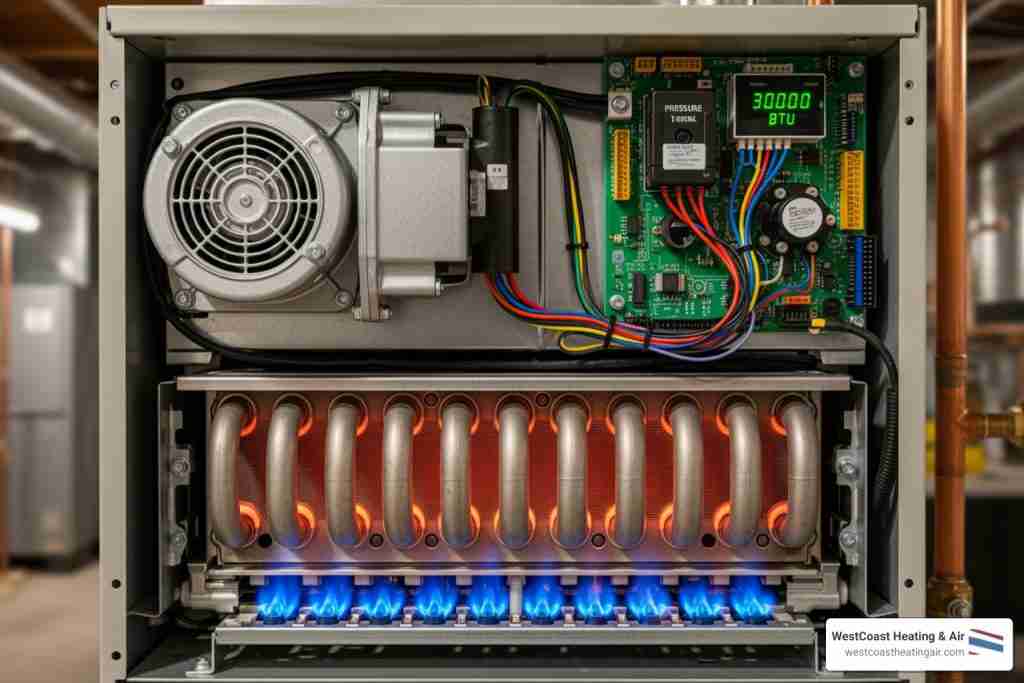
Why a 30,000 BTU Furnace Might Be the Right Fit for Your Home
A 30000 btu furnace is a compact heating solution designed for smaller spaces, additions, or zoned heating applications. If you’re considering heating options for a garage, workshop, apartment, or a specific zone in your home, understanding how BTU ratings work will help you make the right choice. Many homeowners in Puyallup struggle with finding the right-sized heating equipment—too small and you’ll shiver through winter, too large and you’ll waste energy and money on short-cycling and uneven temperatures.
Quick Answer: What You Need to Know About 30,000 BTU Furnaces
- Suitable Space: Generally heats rooms or areas over 900 square feet, depending on insulation and climate
- Common Applications: Garages, workshops, additions, or small homes/apartments
- Fuel Types: Natural gas (most common) or propane with conversion kit
- Efficiency Range: Modern models offer 80-96% AFUE ratings
- Installation Options: Direct-vent, upflow, or horizontal configurations
- Key Consideration: Professional sizing is essential—square footage alone doesn’t determine the right BTU rating
If you’re exploring heating options for your Puyallup home, learn about comprehensive residential heating solutions or schedule a professional furnace installation consultation.
The right furnace size depends on multiple factors beyond just square footage. Climate zone, insulation quality, ceiling height, and how your home is laid out all play a role. A 30,000 BTU furnace sits on the smaller end of residential heating equipment, making it ideal for targeted applications rather than whole-home heating in larger spaces. Understanding the features, installation requirements, and maintenance needs will help you determine if this capacity matches your specific heating needs.
Understanding the 30,000 BTU Furnace: Sizing and Suitability
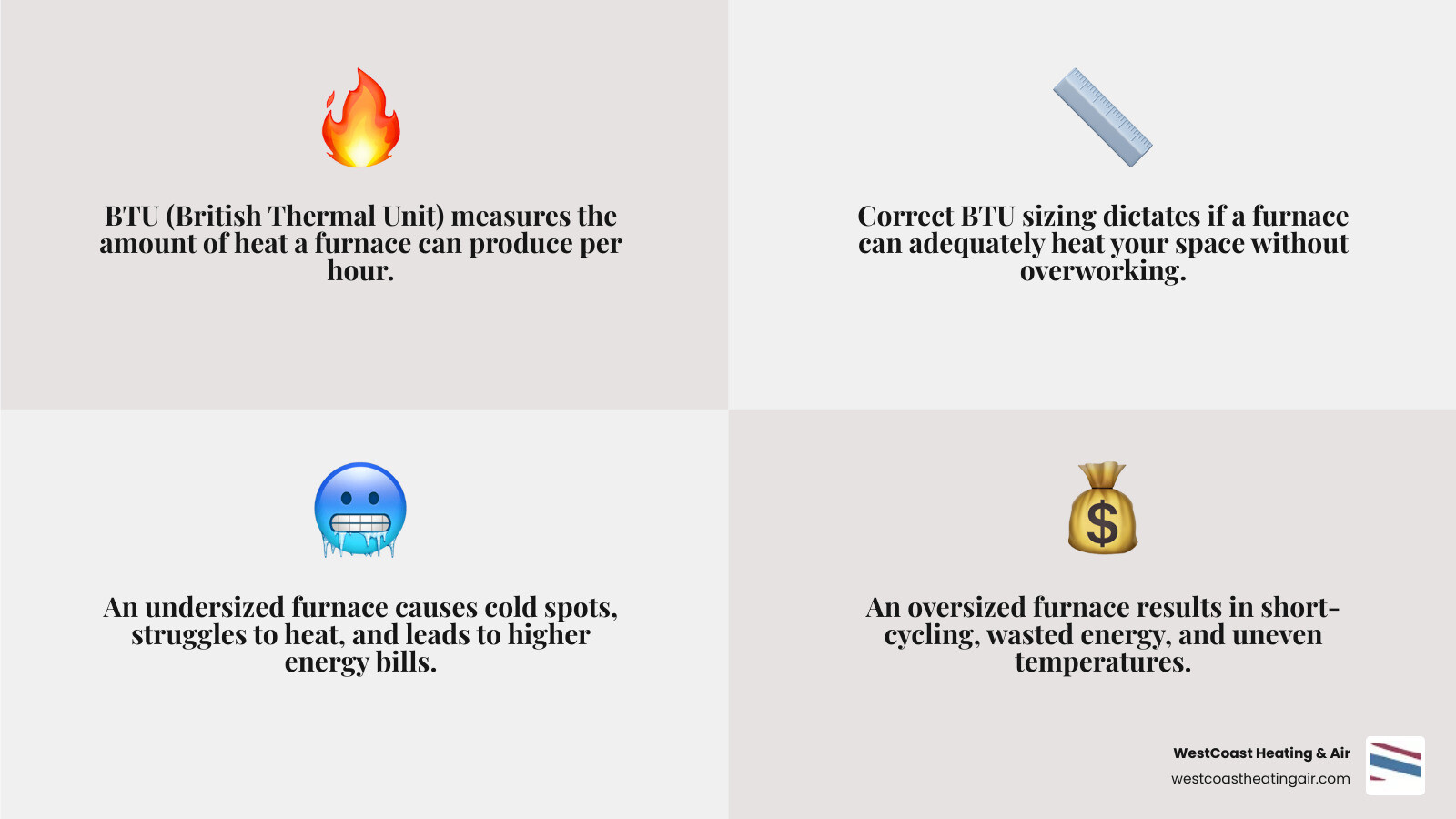
When we talk about furnaces, one of the most important numbers you’ll hear is “BTU.” BTU stands for British Thermal Unit, and it’s essentially a measure of the amount of heat a furnace can produce in one hour. Think of it like horsepower for a car – it tells you how much heating power you’re getting. For a 30000 btu furnace, this means it can generate 30,000 BTUs of heat per hour.
Understanding BTUs is crucial because it dictates whether a furnace can adequately heat your space without overworking or short-cycling. A furnace with too few BTUs for your home won’t keep you warm, leading to cold spots and higher energy bills as it constantly struggles to reach the thermostat setting. Conversely, a furnace with too many BTUs can lead to a different set of problems, which we’ll discuss shortly.
The suitability of a 30000 btu furnace extends to various applications. While not typically recommended for heating an entire large home, it can be perfect for specific scenarios. For instance, our research shows that a 30,000 BTU furnace is often suitable for spaces or rooms greater than 900 square feet, depending on factors like insulation. This makes it an excellent choice for heating large living areas, workshops, detached garages, or even as a supplemental heat source for a specific zone within a larger home in areas like Puyallup, Tacoma, or Sumner.
Factors like the climate in our Pacific Northwest region, the quality of your home’s insulation, and even the number of windows can significantly impact how many BTUs your space truly needs. That’s why relying solely on square footage can be misleading. For a deeper dive into this measurement, you can explore What is BTU Measurement and Why Does It Matter?. If you’re noticing that your current system isn’t keeping up, it might be time to assess your options, and you can learn more about that here: Signs It’s Time to Upgrade Your HVAC System.
Why Correct Sizing is Crucial
Choosing the right furnace size isn’t just about comfort; it’s about efficiency, longevity, and your wallet. We often see homeowners making one of two mistakes: picking a furnace that’s too small or one that’s too large. Both can lead to headaches.
An undersized furnace will constantly run, struggling to reach your desired temperature. This leads to higher energy bills, excessive wear and tear on components, and ultimately, a shorter lifespan for your unit. Imagine trying to heat a large ballroom with a small space heater – it’s just not going to work effectively.
On the flip side, an oversized furnace might seem like a good idea (“more power is always better, right?”). But in reality, it’s often worse for efficiency and comfort. An oversized furnace will heat your space too quickly, reach the thermostat setting, and then shut off. This rapid on-off cycle is known as “short-cycling.” Short-cycling wastes energy, as the furnace uses a lot of power during startup. It also leads to uneven temperatures throughout your home, with some rooms feeling too hot and others too cold. Furthermore, short-cycling prevents the furnace from adequately filtering the air or removing humidity, impacting indoor air quality and comfort. Like an undersized unit, an oversized furnace will also experience increased wear and tear, reducing its overall lifespan.
The industry standard for determining the correct furnace size is a Manual J load calculation. This isn’t just a quick glance at square footage; it’s a detailed assessment that considers every aspect of your home, from insulation levels and window types to ceiling heights and the orientation of your house. It ensures that the furnace we install is perfectly matched to your home’s unique heating demands.
Is a 30,000 BTU Furnace Right for My Space?
Given the nuances of furnace sizing, you might be wondering if a 30000 btu furnace is the perfect fit for your specific needs in University Place, Tumwater, or Roy. As we mentioned, these units are typically on the smaller side of residential heating equipment, making them unsuitable for heating an entire large, sprawling home, especially during colder winter months in our region.
However, they shine in more targeted applications. A 30,000 BTU furnace is an excellent option for:
- Large Rooms or Zones: If you have a particularly spacious living room, a finished basement, or an addition that needs its own dedicated heat source, a 30,000 BTU unit can provide ample warmth. Our research indicates suitability for rooms greater than 900 sq. ft.
- Garages and Workshops: For those chilly mornings in your workshop or keeping your garage comfortable enough for projects, a 30000 btu furnace can be a game-changer.
- Smaller Homes or Apartments: For compact homes or apartments with efficient insulation, this size might be perfectly adequate for whole-home heating.
- Modular or Mobile Homes: These often have specific heating requirements that a 30,000 BTU unit can meet.
The key takeaway here is that while these are general guidelines, the only way to truly know if a 30000 btu furnace is right for your space is through a professional assessment. Our team specializes in providing customized system designs and customer education, ensuring you get the most efficient and comfortable heating solution. For more on how we can help keep your home cozy, visit our page on Residential Heating and Cooling Company.
Types and Key Features of a 30,000 BTU Furnace
Just like cars come in different models and with various features, so do furnaces. Even within the 30000 btu furnace category, you’ll find a range of options regarding fuel type, efficiency, and operational characteristics. Understanding these differences will help you make an informed decision for your home.
Common Furnace Types
The primary distinction among furnaces often comes down to their fuel source:
- Gas Furnaces: These are the most common type, especially in our service areas like Steilacoom and Orting, where natural gas lines are often readily available. Natural gas furnaces are known for their powerful, consistent heat. Many models, like the Goodman GMEC960302BN mentioned in our research, are high-efficiency gas furnaces. A significant advantage is that many natural gas furnaces can be converted to use propane with a simple conversion kit, offering flexibility if natural gas isn’t accessible. Some direct-vent gas furnaces, like a Williams model we researched, can even operate without electricity, making them a fantastic option for staying warm during power outages – a real comfort during those unexpected Pacific Northwest storms! You can learn more about these powerful units on our Gas Furnace page.
- Electric Furnaces: While less common for whole-home heating in colder climates due to higher operating costs (compared to gas), electric furnaces can be a viable option for smaller spaces or as a backup heat source. They don’t require gas lines or venting, which simplifies installation.
- Direct-Vent Systems: This is an important feature, especially for smaller, localized heating. A direct-vent furnace draws combustion air from outside and vents exhaust gases directly outside, rather than using a chimney. This makes them highly efficient and safe, as they don’t draw heated air from inside your home for combustion or vent exhaust into your living space. The Williams 30,000 BTU/hour Direct-Vent Furnace is a prime example of this type, often used for specific rooms or additions.
High-Efficiency Features to Look For
When investing in a 30000 btu furnace, looking for high-efficiency features can lead to significant savings on energy bills and improved comfort.
- AFUE Rating: This stands for Annual Fuel Utilization Efficiency, and it’s essentially a miles-per-gallon rating for furnaces. It tells you how much of the fuel consumed is converted into usable heat for your home, versus how much is lost through the exhaust. For example, a 96% AFUE furnace means that 96 cents of every dollar you spend on fuel goes directly to heating your home, with only 4 cents lost. Our research highlights models with 96% AFUE, which is considered highly efficient.
- ECM Blower Motors: Electronically Commutated Motors (ECM) are a fantastic feature to look for. Unlike traditional single-speed motors, ECM motors are highly energy-efficient and can vary their speed. This allows them to deliver just the right amount of airflow for optimal comfort and efficiency, reducing noise and energy consumption.
- Variable-Speed Airflow: Hand-in-hand with ECM motors, variable-speed airflow systems offer quieter operation and ramp up and down based on your home’s heating demand. This results in more consistent temperatures, better humidity control, and a quieter home environment, avoiding those sudden blasts of hot air.
- Self-Diagnostic Controls: Modern furnaces, including some 30,000 BTU models, come with self-diagnostic control boards. These systems can monitor the furnace’s operation and display fault codes if an issue arises. This feature can save time and money on service calls by helping technicians quickly identify and resolve problems.
Choosing a furnace with these high-efficiency features means you’re not just getting heat; you’re getting smart, cost-effective, and comfortable heat. To explore more about making your heating system as efficient as possible, check out The Best High-Efficiency Heating Options for Your Home.
Installation and Maintenance Essentials
Bringing a new 30000 btu furnace into your home, whether it’s for a new addition in Spanaway or replacing an older unit in SeaTac, involves more than just picking the right model. Proper installation and diligent maintenance are absolutely vital for safety, efficiency, and the long life of your heating system.
Installation Considerations
While a 30000 btu furnace might be smaller than some whole-home units, its installation still requires professional expertise. Our certified technicians ensure that every aspect of the installation adheres to local codes and manufacturer specifications, guaranteeing safe and efficient operation.
- Venting Requirements: For gas furnaces, proper venting is paramount. Direct-vent systems, common for 30,000 BTU units, require specific pathways through an exterior wall. Incorrect venting can lead to safety hazards, including carbon monoxide leaks, which is why we always emphasize professional handling.
- Configuration: Furnaces come in various configurations to fit different home layouts. Upflow furnaces blow heated air up into ductwork, often installed in basements or utility closets. Horizontal furnaces are designed to lie on their side, ideal for attics or crawl spaces. Our research shows models like the Goodman GMEC960302BN are designed for both upflow and horizontal installations, offering flexibility.
- Ductwork Inspection: Even if you’re only heating a specific zone, the ductwork connected to your new furnace needs to be in top shape. Leaky or improperly sized ducts can drastically reduce efficiency and comfort, making your new furnace work harder than it needs to.
- Thermostat Compatibility: Modern furnaces often require specific thermostats to open up their full potential, especially those with multi-stage or variable-speed operation. Our research on Goodman models highlights compatibility with ComfortNet communicating, two-stage, or single-stage thermostats. Ensuring the right thermostat is installed allows your 30000 btu furnace to operate at peak efficiency and provide precise temperature control.
A professional installation is not just about hooking up pipes and wires; it’s about optimizing your system for maximum performance and ensuring the safety of your home and family. For a comprehensive overview of what to expect during this process, read our guide on What to Expect During an HVAC Replacement.
Long-Term Furnace Care and Maintenance
Once your 30000 btu furnace is expertly installed, the journey to a warm and comfortable home continues with regular maintenance. Think of it like regular oil changes for your car – essential for performance and longevity. Neglecting maintenance can lead to unexpected breakdowns, reduced efficiency, and costly repairs down the line.
Here are some essential maintenance tasks for your 30000 btu furnace:
- Annual Tune-Ups: We can’t stress this enough! An annual professional tune-up is the best way to keep your furnace running efficiently and safely. During these visits, our technicians inspect all components, clean the system, and identify any potential issues before they become major problems. This is particularly important in areas like Pierce County, where furnaces work hard through the winter. Learn more about the benefits of regular service: How Often Should You Get Your Furnace Service? and Why You Need a Furnace Tune-Up in Pierce County.
- Filter Replacement: This is one of the easiest and most impactful DIY tasks you can do. A clogged air filter restricts airflow, forcing your furnace to work harder and reducing its efficiency. We recommend checking your filter monthly and replacing it every 1-3 months, depending on usage and household conditions.
- Safety Checks: Part of a professional tune-up includes checking for gas leaks, proper combustion, and ensuring your carbon monoxide detectors are working correctly. Carbon monoxide is an odorless, colorless gas that can be deadly, so its prevention is non-negotiable. We’ve written extensively on this: How to Prevent Furnace Carbon Monoxide Problems and How to Prevent Furnace Carbon Monoxide Leaks in Puyallup.
- Keep Vents Clear: Ensure that nothing is blocking your furnace’s air intake or exhaust vents, especially for direct-vent models. Snow, leaves, or debris can obstruct these, leading to operational issues.
While there are simple tasks homeowners can handle, like changing filters, professional maintenance is indispensable. We provide comprehensive care to keep your heating system in Sumner, Tacoma, and beyond running smoothly. For some simple upkeep tips you can do yourself, check out 3 Easy DIY HVAC Upkeep Tasks Homeowners Can Do Between Professional Visits.
Conclusion: Partner with an Expert for Your Heating Needs
Choosing and installing a 30000 btu furnace is a significant decision for your home’s comfort and energy efficiency. We’ve explored what these compact yet powerful units are, the spaces they’re best suited for (often rooms over 900 sq. ft., garages, or workshops), and the crucial importance of correct sizing to avoid the pitfalls of both undersized and oversized systems. We’ve also digd into the various types available, from natural gas and propane options to direct-vent systems, and highlighted key high-efficiency features like impressive AFUE ratings and ECM blower motors that can save you money and improve your comfort.
The journey from considering a new furnace to enjoying consistent warmth in your Puyallup home is best steerd with expert guidance. Our team at WestCoast Heating & Air is dedicated to providing customized system design, educating our customers, and delivering top-quality products and service, backed by over 20 years of local experience in areas like University Place, Tumwater, and Orting.
Whether you’re looking to heat a specific zone, replace an aging unit, or simply want to understand your options, we’re here to ensure your heating solution is perfectly custom to your needs. Don’t leave your home comfort to chance; partner with professionals who understand the unique heating demands of our Pacific Northwest climate.
Learn more about professional gas furnace installation and service with WestCoast Heating & Air today.